

Some years the Summer Solstice found me alone on the shore of the Vineyard, standing waist deep in the ocean at a place called Dogfish Bar, stars whirling above. There since before midnight, I was one of the very few to watch the first glow of summer appear as a pale blue line on the northeast horizon. Day begins there–and then–at 3:45 AM. From the windows of a jet one notices night turn quickly into day, of course, but those angling adventures were times I really felt Earth’s slow, inexorable rotation. Admittedly my senses were finely tuned, as sharks enjoy Vineyard waters on June nights too.
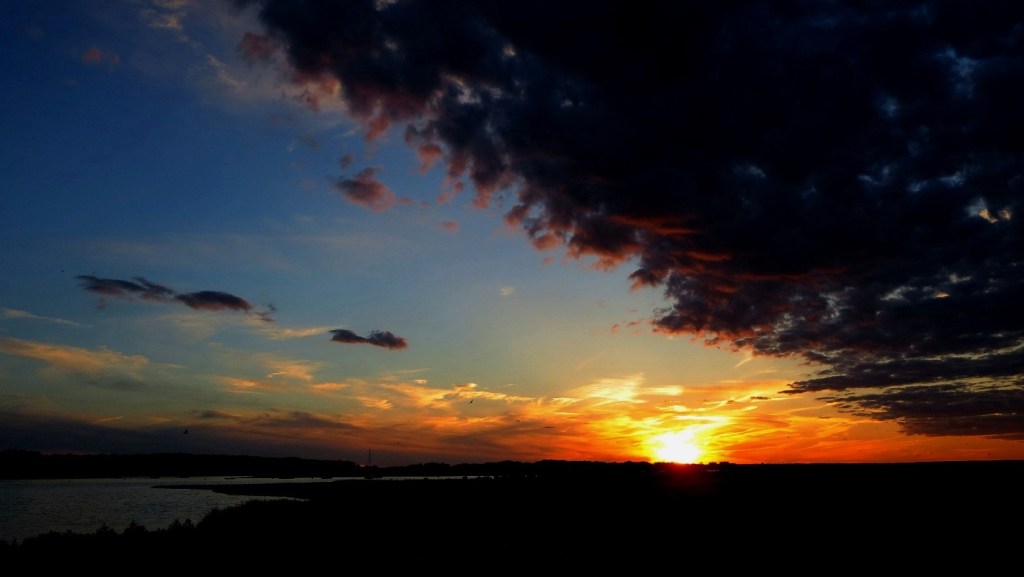
Daylight on that date is always more than 15 hours long. Our longest night, coming soon, is the winter equinox on December 21st (can you guess how long that night will be?)
A year on Earth is 365 ¼ days. That’s why we have a leap year every four years. If we didn’t, summer in the northern hemisphere would fall in January after 750 years or so. Like our orbit, our planetary rotation began during the formation of the solar system, and with negligible friction from the moon it continues, causing us all to ride a seesaw: day and night, high and low tides, currents of fresh and salt water, weather and temperatures, atmospheric jet streams, and movement of windborne soil. Even Antarctica has seasons.
And there is a rhythm to it more complex than simply spring, summer, fall and winter, because Earth wobbles as it spins in its elliptical orbit. Pythagoras coined the expression “the music of the spheres”. Earth is consistent but not rigid; it dances to that silent music in a big, dark dance hall.
The dance is critical for life. Like a blender, the constant spinning and tilting of our globe keeps the ingredients mixed, creates the global consistency life needs. Day and night moderate our temperature and enable a rest period for all, and exchange the air and ocean waters, adding further moderation. In addition, our inner core of iron and nickel, which rotates separately from the surface, creates a magnetic field. That keeps solar wind radiation and cosmic rays from harming life, while it is also responsible for the Northern Lights. Not a bad deal for a few volcanoes.
Go out and enjoy the night sky. The atmosphere is dry now and the view is better. Any leftover summer humidity has escaped from the atmosphere along with the warmth, leaving skies crystal clear for amateur astronomy.
While listening to the last few ground crickets the other night, I said hello to Venus. Did you know you are seeing Venus two minutes in the past? Try to grasp this: Voyager 1, launched in 1977, is now a Light Day (24 hours at 186,000 miles/second) from Earth. Dizzy yet? Let’s head back home. Like my crickets, life is mostly at rest here in southern New England.
But it’s still alive. Bare deciduous trees maintain their strength by dropping leaves, as frozen ground inhibits water’s availability. Within their trunks, water will not freeze until the temperature is far below zero, protecting them from internal damage. Acorns, which have finally stopped banging on my roof like cannonballs, will feed birds, mammals, and insect larvae even under the snow. Dried buds on perennials are dormant, waiting to be resurrected by longer days. Plants and shrubs have stored nutrients in their root systems. Some require a cold spell (vernalization) or cold-moist stratification to bloom or for seeds to sprout. Monarch butterflies depend on those conditions, as milkweed needs cold to germinate.
A few stoneflies and moths remain active. So do the white-footed mice renting space in my attic. Gray squirrels and flying squirrels are busy. Their late winter babies will be born in nests and dens. More than half of our forest lives ride Earth’s seesaw between activity and rest. I too will rest (and probably watch too much basketball).
We live in what has been called the “Goldilocks Zone”. Our Sun is a stable G-type star. We are the perfect distance from the Sun for water to usually remain in a liquid state. Earth is also the perfect size: it has enough mass and gravity to have a steady atmosphere, which traps the right amount of heat and helps protect us from that interstellar radiation. You can’t escape the fundamental laws of physics. Lucky? If this is not a miracle, it’s awfully close. Might we mean “the spiritual laws of physics”?

Consistency and flexibility in equal measure favors life. Come April this winter darkness will retreat to the southern hemisphere, and lead to an explosion here: flowers, bees, migrants and vagrants, babies, rains and rivers in our gentle homeland. The forest will sing–and dance. Your own circadian rhythm will automatically join our tilt toward the sun, and the poetry in your soul will enjoy sunset a little more. When the next summer solstice comes around, I too might watch that sun set from Wolf Rock…until it’s no more than a pale blue line in the southwest. There’s a lot to be thankful for.
George Jacobi
Thanks to Henriette Herzfeld for the thoughts.
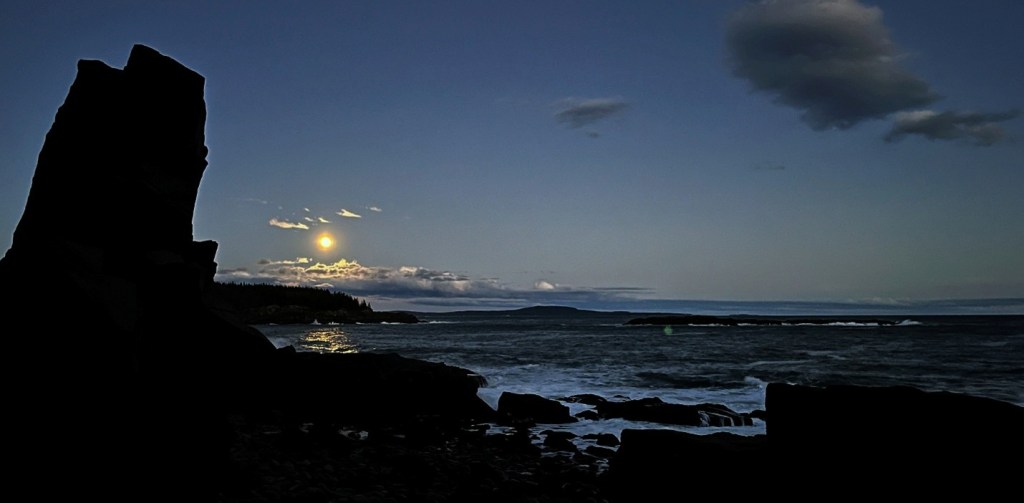
Thanks to Charlie Jacobi for the middle photo of moonrise.


Leave a Comment